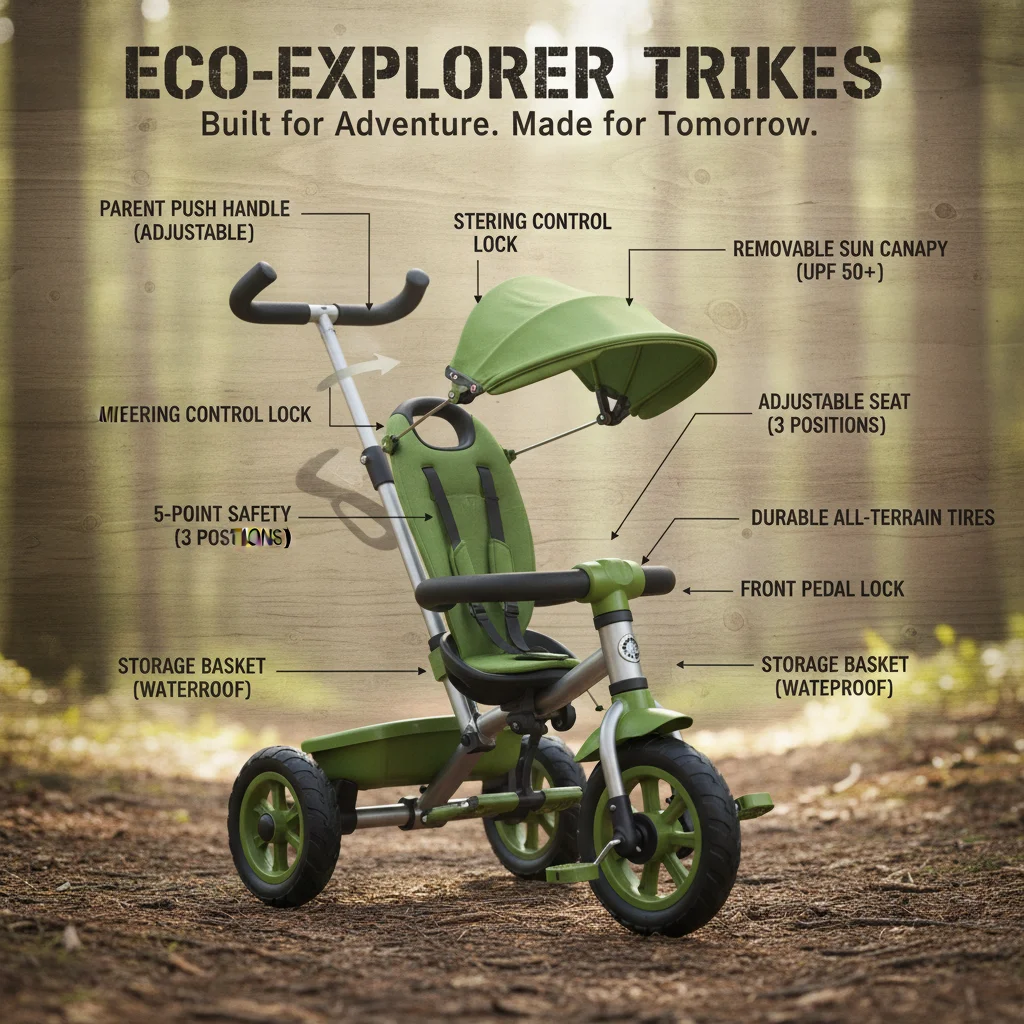
When sourcing ride-on toys for the toddler market, the challenge often lies in finding a balance between dynamic playability and rigorous safety standards. For wholesalers and brands, identifying a reliable tricycle kids Supplier involves more than just comparing price points; it requires a deep dive into structural stability, material non-toxicity, and the manufacturer's ability to scale production without compromising quality.
The complexity of the children's vehicle industry is evident in the diverse requirements for different age groups. While a Baby Balance Bike focuses on equilibrium, a Children's Hand-Pushed Tricycle must prioritize parental control and toddler security. The integration of advanced features, such as anti-rollover structures, has become a critical differentiator for products designed for the 1 to 3-year-old demographic, where motor skill development is at its most volatile stage.
Understanding these technical nuances allows businesses to reduce market entry risks and increase sell-through rates. This guide analyzes the critical criteria for evaluating manufacturing partners and examines how specific design innovations, offered by a professional tricycle kids Supplier, translate into tangible value for the end consumer and the retail brand.


Engineering for toddlers aged 1 to 3 requires a precise understanding of the center of gravity. At this age, children are transitioning from assisted movement to independent steering, meaning the vehicle must provide enough stability to prevent tipping while allowing the "wobble-steer" movement necessary for coordination. This is particularly evident in the Peanut Style Twister Car, where the shape is not merely aesthetic but serves to distribute weight evenly across the base.
A professional manufacturing approach integrates injection molding precision with structural reinforcement. By utilizing high-grade, non-toxic plastics, the chassis can withstand repeated impact without fracturing, which is a primary concern for high-traffic residential or daycare environments. The synergy between the wheel base width and the seat height determines the overall safety profile of the vehicle.
When auditing a supplier, the most critical metric is the verification of global certifications. Compliance with EN71, ASTM, and CE standards is not optional; it is the baseline for regional distribution. These certifications ensure that the materials used are free from harmful phthalates and that the mechanical edges are rounded to prevent lacerations, providing a documented safety trail for the importer.
The true measure of a high-performance ride-on is the integration of a wide-base stability system. By lowering the center of gravity and extending the wheel track, the risk of tipping during sharp turns is virtually eliminated, transforming a potential hazard into a safe learning experience for the child.
Beyond certification, the durability of the assembly process determines the long-term ROI for the retailer. Rigorous multi-stage testing, including impact resistance and load-bearing trials, ensures that the product does not fail prematurely under real-world conditions. This reduces the rate of returns and protects the brand equity of the wholesaler.
The speed of sampling is a key indicator of a factory's technical maturity. A streamlined prototype iteration process allows brands to test market trends, such as the "Peanut Style" aesthetics, and make functional adjustments before committing to mass production. This agility is essential in the fast-moving toy industry where consumer preferences shift seasonally.
Furthermore, the flexibility of Minimum Order Quantities (MOQ) allows smaller brands to remain lean. By offering optimized wholesale flexibility, manufacturers enable retailers to test new SKUs without overwhelming their inventory, facilitating a more responsive and data-driven procurement strategy.
Children's ride-ons serve different purposes depending on the environment. In residential indoor settings, the focus is on floor-safe wheels and quiet operation, whereas outdoor applications require wear-resistant materials and enhanced stability for uneven surfaces. Products like the Yo-yo car are particularly effective in open-space environments where toddlers can exercise their gross motor skills through intuitive movement.
Commercial applications, such as kindergartens or maternal-child centers, demand products with higher durability and easier sterilization. In these settings, the "anti-rollover" feature becomes a critical liability reducer, ensuring that multiple children can interact with the products while maintaining a safe operational boundary.
The industry is shifting toward eco-friendly, non-toxic polymers that not only meet safety standards but also reduce the environmental footprint of production. Modern injection molding allows for the creation of seamless structures, which eliminates the need for mechanical fasteners that could potentially loosen over time, thereby enhancing the structural integrity of the vehicle.
Moreover, the integration of optional functional modules—such as sound and light components—is moving toward modular designs. This allows manufacturers to offer different SKU levels (from basic to premium) using the same core chassis, optimizing production costs while providing diverse options for different market segments.
Looking ahead, the focus is likely to move toward personalized ergonomics. Adjustable seating and customized grip sizes based on the specific growth phases of toddlers (12 months vs 36 months) will provide a more tailored experience, increasing the usable lifecycle of the product for the parent.
One of the primary challenges for global buyers is the gap between concept and mass production. This is typically solved through comprehensive OEM/ODM services where the manufacturer provides joint development of trending designs and patent sharing. This collaboration ensures that the final product is not only aesthetically appealing but also manufacturable at scale.
Logistical bottlenecks are often mitigated through professional export expertise. By handling hassle-free inspection and customs clearance, a source factory can reduce the lead time from the production line to the warehouse, ensuring that hot products reach the market during peak demand periods.
Finally, the risk of inconsistent quality across large batches is addressed through strict adherence to regional safety standards and multi-stage testing. Implementing lean production management allows the factory to maintain high output without sacrificing the "parent's heart" approach to safety and quality control.
| Metric | Standard Supplier | Expert Solution | Impact on Brand |
|---|---|---|---|
| Sampling Speed | 14-21 Days | Fast-Track | Faster Market Entry |
| Compliance | Basic Testing | EN71/ASTM/CE | Zero Regulatory Risk |
| Customization | Limited Colors | Full Identity | Stronger Brand Equity |
| MOQ Flexibility | High Volume | Low MOQ Options | Optimized Inventory |
| Design Support | Generic Catalog | Joint ODM | Competitive Edge |
| Quality Control | Random Batch | Multi-Stage | Lower Return Rates |
This product is specifically engineered for toddlers between 1 and 3 years old. The design focuses on safety and early balance development, ensuring that the vehicle is stable enough for children who are just beginning to coordinate their motor skills.
Yes, the products provide full documentation and compliance for EN71, ASTM, and CE safety standards. This ensures that the materials are non-toxic and the structural design is safe for global distribution in Europe, North America, and other regulated markets.
Absolutely. Comprehensive Branding Customization is available, including custom decals, exclusive color schemes, and branded logos. This allows wholesalers to build their own brand identity while leveraging professional factory-direct manufacturing.
The anti-rollover design utilizes a specialized center of gravity and a wide-wheel base. By increasing the footprint of the vehicle and keeping the weight distributed low, the car is prevented from tipping over even during sharp turns or erratic toddler movements.
Yes, wholesale flexibility is provided with low MOQ options. This is designed to help new brands and smaller retailers test the market viability of specific models without requiring a heavy initial capital investment.
Personalization options include the integration of push handles for parents, storage baskets for toys, canopies for sun protection, and enhanced sound/light modules to create higher-value SKUs for different price points.
Selecting a tricycle kids Supplier is a strategic decision that directly impacts the safety of the end user and the profitability of the distributor. By prioritizing manufacturers who combine rigorous EN71/ASTM compliance with innovative stability features, such as the anti-rollover wide-base system, businesses can ensure a product that is both market-ready and parent-approved. The shift toward ODM collaboration further allows brands to stay ahead of aesthetic trends while maintaining structural integrity.
For enterprises looking to scale their children's ride-on portfolio with certified quality and factory-direct pricing, partnering with a source factory that understands the "parent's heart" is essential. We invite you to explore our professional manufacturing solutions and customization capabilities at www.wqlkidsrideon.com to build a safer, more joyful riding experience for children worldwide.


Hit enter to search or ESC to close