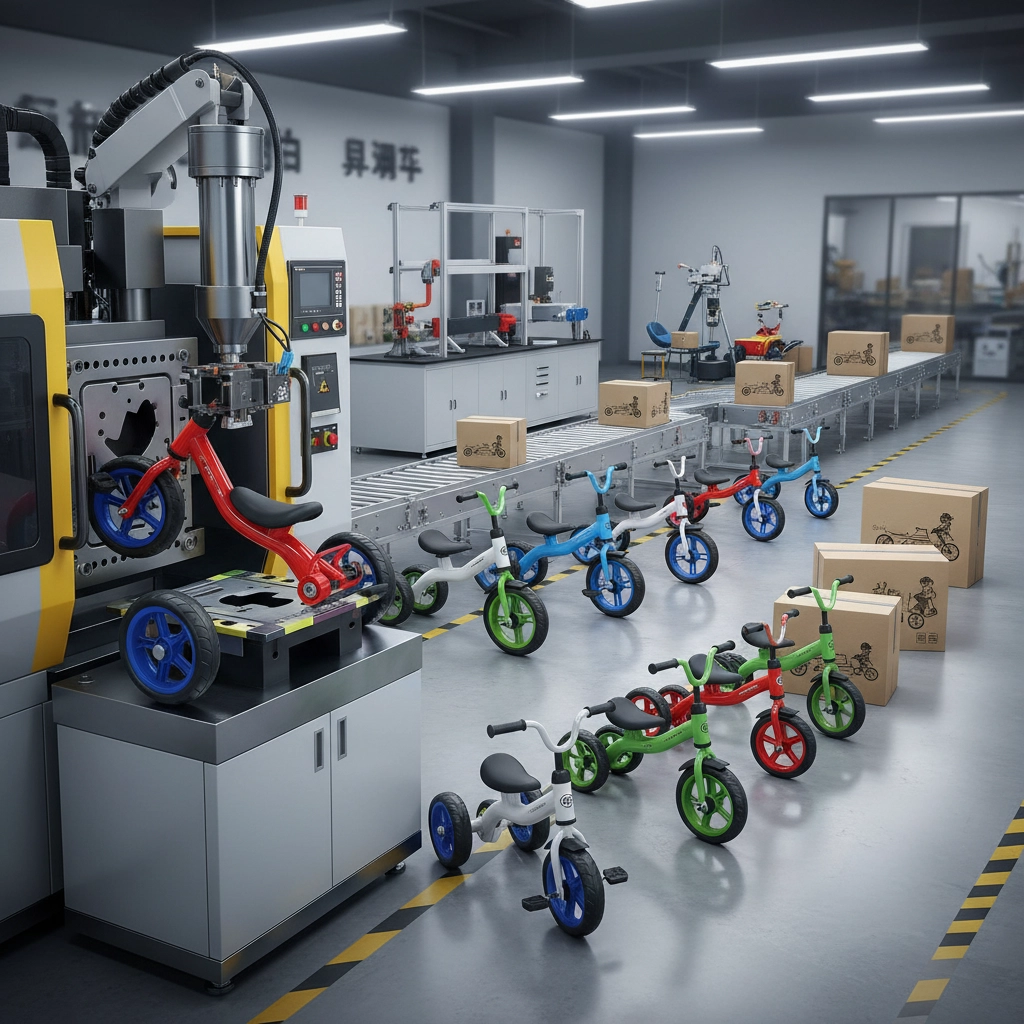
Finding a reliable trikes with push handle Manufacturer is a critical strategic decision for brands in the juvenile ride-on sector. As parents increasingly prioritize safety and developmental support, the demand for tricycles that blend child autonomy with parental control has surged globally. In the specialized field of toy manufacturing, the integration of a push handle transforms a simple tricycle into a versatile mobility tool for toddlers.
Procurement professionals often struggle with the balance between cost-efficiency and rigorous safety certifications. The challenge lies in identifying a source factory that can manage the complex transition from a guided push-stroller experience to an independent riding phase without compromising on structural integrity or material safety. This gap often leads to inventory risks or compliance failures in strict markets like Europe and North America.
This guide provides a comprehensive framework for evaluating manufacturing partners, analyzing essential technical specifications for push-handle trikes, and understanding how OEM/ODM customization can create market-competitive SKUs. By focusing on material compliance and ergonomic design, businesses can establish a high-demand product line that meets international safety standards.

Core Requirements for Push-Handle Tricycle Production

The production of tricycles with push handles requires a multidisciplinary approach to engineering. Unlike simple balance bikes, these products must support the weight of the child while remaining maneuverable for the adult. A professional manufacturer must integrate stable anti-tip designs with wide seating to enhance the child's body coordination during the early stages of riding.
HEBEI WAQILE CHILDREN TOY CO., LTD utilizes integrated production lines for injection molding and assembly to ensure that every joint and connection point is reinforced. By controlling the process from raw material to finished product, the manufacturer eliminates the variance typically found in multi-vendor assembly, resulting in a more stable and durable frame.
Analyzing the Ergonomics of Parental Control Systems
The push handle is not merely an accessory but a primary control interface. Effective design requires a balance between handle height, grip comfort, and the pivot point relative to the tricycle's center of gravity. An improperly positioned handle can lead to parental wrist strain or unpredictable steering behavior, which poses a safety risk to the toddler.
Modern solutions prioritize multi-position adjustable handles and shock-absorbing wheels to provide a comfortable travel experience. By analyzing the interaction between the adult's pushing force and the child's natural movement, manufacturers can create a seamless bridge between a stroller and a tricycle, fostering joyful growth and physical equilibrium.
Material Selection and Global Safety Compliance
In the toy manufacturing industry, material toxicity and impact resistance are non-negotiable. The use of eco-friendly, non-toxic polymers is essential to meet the stringent requirements of international markets. Every component, from the chassis to the grip handles, must undergo impact resistance testing to prevent shattering under stress.
Compliance with EN71, ASTM, and CE standards is the benchmark for any reputable trikes with push handle Manufacturer. These certifications ensure that the product is free from harmful chemicals and designed to prevent entrapment or tipping. Providing full documentation for these certifications allows B2B buyers to enter global markets with confidence and reduced legal risk.
Comparative Performance of Ride-On Configurations
Different ride-on configurations serve distinct developmental milestones. While a simple balance bike focuses on equilibrium, a hand-pushed tricycle provides a transition period where the parent manages the direction while the child explores the sensation of movement. The following conceptual index illustrates the relative focus of different ride-on types across key development metrics.
This illustrative framework demonstrates that while Balance Bikes score highest in equilibrium development, Push-Handle Tricycles provide the highest score in parental control and early-stage safety, making them the ideal entry point for children aged 1-3 years.
OEM/ODM Strategies for Market Differentiation
To avoid product homogenization, brands must leverage OEM/ODM capabilities to create unique SKUs. This extends beyond simple logo placement to include functional fine-tuning, such as integrating storage baskets, adjustable seats, or customized canopies. Trend-driven designs, like the "Peanut" aesthetic, allow brands to capture the "Internet Popular" market segment.
Collaborative joint development and patent sharing are powerful tools for staying ahead of the competition. By working with a source factory that offers fast prototyping, brands can test market trends rapidly and launch new designs without the traditional long lead times associated with overseas manufacturing.
Mitigating Common Procurement Risks in Toy Manufacturing
One of the most significant risks in sourcing ride-ons is the gap between sample quality and mass production. This is often caused by a lack of in-house quality inspection. A direct-export source factory reduces this risk by operating comprehensive internal production lines for injection molding and assembly, ensuring consistency across thousands of units.
Additionally, high Minimum Order Quantities (MOQs) can stifle a brand's ability to scale. Flexible wholesale models with low MOQs allow businesses to maintain lean inventory while testing new color schemes or feature sets. This agility is essential for responding to seasonal trends and avoiding dead stock in the fast-moving toy market.
Manufacturer Evaluation Decision Framework
When choosing a trikes with push handle Manufacturer, buyers should move beyond price-per-unit and evaluate the total value proposition. The decision should be based on the supplier's ability to provide a seamless bridge from conceptual vision to market reality, backed by certified safety documentation and supply chain agility.
| Evaluation Metric | Standard Supplier | Professional Solution | Business Impact |
|---|---|---|---|
| Lead Time | Variable/Long | Fast Prototyping | Faster Market Entry |
| Customization | Basic Colors | Full Branding/Features | Higher Brand Equity |
| Compliance | Basic Certificates | EN71, ASTM, CE | Reduced Legal Risk |
| MOQ Flexibility | High Minimums | Flexible Low MOQs | Optimized Cash Flow |
| Design Approach | Generic Models | Trend-Driven/Patented | Competitive Edge |
| Quality Control | Third-Party Only | In-House Integrated | Lower Defect Rates |
By applying this relative evaluation framework, procurement managers can identify partners who offer not just a product, but a scalable growth engine for their children's ride-on line.
Frequently Asked Questions
Depending on the target market, products should hold EN71 (Europe), ASTM (USA), and CE certifications. These ensure the materials are non-toxic and the structure is safe for toddlers.
Yes, professional manufacturers offer OEM customization to adjust handle height, grip materials, and detachment mechanisms to suit specific market requirements.
A source factory eliminates intermediaries by managing injection molding and assembly in-house, providing direct-factory pricing and more efficient quality control.
They are specifically engineered for toddlers aged 1 to 3 years, providing stability and parental guidance before they transition to independent pedal bikes.
Yes, manufacturers with end-to-end solutions provide rapid prototyping to help brands test market trends and launch products faster.
Common customizations include storage baskets, protective canopies, upgraded sound/light modules, and adjustable seating configurations.
Conclusion
Selecting the right trikes with push handle Manufacturer is a balance of technical scrutiny, safety compliance, and supply chain flexibility. By prioritizing partners who offer integrated production and certified quality, brands can ensure their products provide a safe and joyful developmental experience for toddlers while maintaining a competitive edge through customized, trend-driven designs.
For businesses looking to launch or expand their high-demand ride-on line, detailed product specifications and OEM/ODM options can be explored at www.wqlkidsrideon.com to align manufacturing capabilities with market vision.