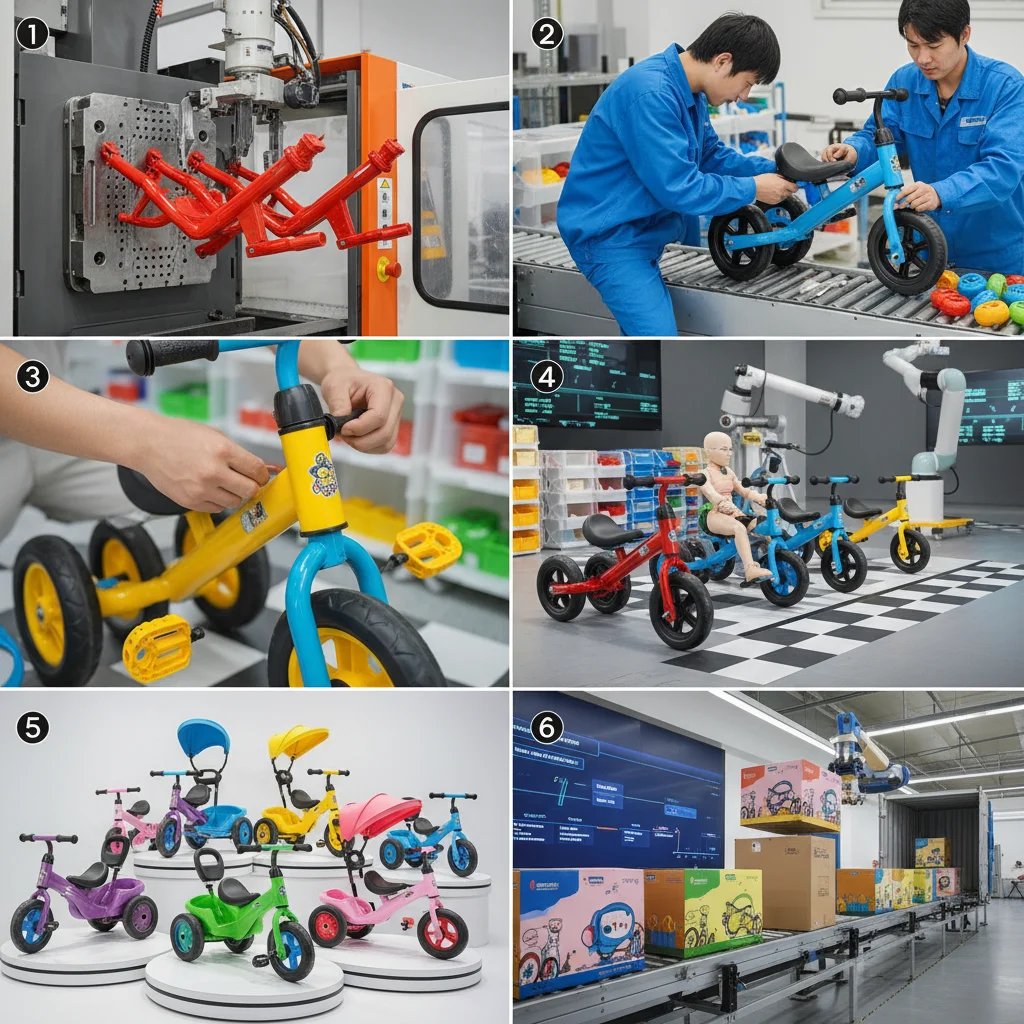
Selecting the right ride-on for a toddler involves more than just picking a bright color; it requires a balance between motor skill development and rigorous safety engineering. For children around two years old, the transition from assisted walking to independent steering is a critical developmental milestone that demands specific vehicle geometry and material stability.
The market has shifted away from simple plastic toys toward multi-stage adaptive vehicles that can evolve alongside the child. This transition is driven by a growing parental demand for sustainable, long-term value and a deeper understanding of how physical activity contributes to early childhood coordination and cognitive growth.
Whether you are a retail buyer or a parent, understanding the technical specifications of a professional trikes for two years old Manufacturer is essential to ensure the product meets international safety certifications while providing a seamless user experience.


At twenty-four months, children are refining their gross motor skills and beginning to understand the concept of propulsion. A tricycle for this age group must prioritize a low center of gravity to prevent tipping during erratic turns, as their balance is still developing.
The psychological impact of early independent mobility cannot be understated. By providing a vehicle that allows them to steer and pedal—even with parental guidance—children build confidence and spatial awareness, which are foundational for later bicycle riding.
Industrial-grade safety begins with the chassis. High-carbon steel is preferred over lightweight alloys or plastics for primary frames because it offers superior static load capacity and impact resistance. A reinforced steel frame ensures that the vehicle does not warp under the weight of a growing child, maintaining structural integrity over several years of use.
Beyond the frame, the choice of polymers is critical. Non-toxic, impact-resistant plastics are essential for touch-points and guards. These materials must pass rigorous drop tests and chemical leaching simulations to comply with global standards like EN71 and CE, ensuring that the ride-on is safe for toddlers who may frequently come into contact with the surfaces.
Tire technology also plays a pivotal role in the user experience. Puncture-proof rubber tires are becoming the industry standard for high-end trikes. Unlike pneumatic tires, these require zero inflation and are resistant to thorns or glass, reducing the maintenance burden on parents and ensuring the vehicle remains operational in various outdoor terrains.
The "adaptive" concept solves a major pain point in the toy industry: the rapid obsolescence of products as children grow. A 4-in-1 system allows a single vehicle to transition through different stages of childhood development.
Adaptive design transforms a purchase from a short-term toy into a long-term developmental tool, transitioning from a parent-steered push trike for 1-year-olds to an independent ride-on for 6-year-olds.
In the WQL-066-12 model, this is achieved by removing components such as the push handle and safety guards as the child gains autonomy. This staged progression ensures the child is never overwhelmed by the vehicle's complexity nor limited by its size, effectively extending the product's lifecycle to over five years.
From a logistical and ownership perspective, the cost of ownership is defined by maintenance requirements. Traditional tricycles often struggle with tire deflation and chain exposure. Modern engineering addresses this through fully covered chain guards and high-density rubber composites.
When evaluating the operational value of a tricycle, we look at the "Maintenance-Free Index." By eliminating the need for air pumps and frequent lubricant applications, manufacturers increase the product's appeal to the modern, time-constrained parent.
For global wholesalers and brands, the ability to customize aesthetic and functional elements is a key competitive advantage. OEM/ODM services allow businesses to align product colors—such as Khaki, Gray, or Pink—with specific regional market trends or brand identities without compromising the underlying structural safety of the carbon steel frame.
Efficient supply chain management from manufacturing hubs like Hebei, China, further reduces the landing cost. By optimizing packaging dimensions (e.g., 65x38x29cm), manufacturers can maximize container density, significantly lowering shipping costs per unit and improving the overall ROI for the importer.
The industry is moving toward "smarter" materials that offer higher strength-to-weight ratios. While high-carbon steel remains the gold standard for stability, future R&D is focusing on reinforced polymer composites that can match the durability of steel while reducing the total weight of the vehicle for easier transport.
Sustainability is also becoming a non-negotiable requirement. The shift toward 100% recyclable non-toxic plastics and bio-based rubber is accelerating, as parents increasingly scrutinize the environmental footprint of the toys they purchase for their children.
Integration with developmental psychology is another trend. We are seeing more vehicles designed with "educational triggers"—features that encourage specific motor skills or sensory responses—turning the simple act of riding into a structured learning experience.
When selecting a supplier or a product, the decision should be based on a multi-dimensional matrix rather than price alone. The trade-off between a "basic" tricycle and a "premium adaptive" one usually manifests in the frame's lifespan and the safety certifications provided.
A basic plastic trike may suffice for a few months, but an adaptive carbon steel model supports a child from age 1 through 6, meaning the cost-per-year of use is actually lower for the premium option. Safety certifications such as ISO, CE, and 3C serve as the primary risk mitigation tool for distributors.
The following framework illustrates the relative suitability of different construction methods based on common buyer requirements and child developmental stages.
| Evaluation Factor | Standard Plastic Trike | Adaptive Steel Trike | Recommended Use |
|---|---|---|---|
| Frame Lifespan | 1-2 Years | 5+ Years | Long-term growth |
| Tire Maintenance | High (Air/Wear) | Zero (Puncture-proof) | Low-maintenance |
| Safety Certification | Basic / Optional | CE/EN71/ISO/3C | International Export |
| Adaptability | Single Mode | 4-in-1 Adaptive | Multi-age utility |
| Weight Capacity | Low (approx 20kg) | High (up to 50kg) | Sturdy build |
| Market Appeal | Low Margin | Premium Appeal | High-end retail |
High-carbon steel provides industrial-grade structural stability and a significantly higher weight capacity (up to 50kg) compared to plastic alternatives. This ensures that the tricycle does not bend or break under stress, providing a safer environment for children as they grow and their riding style becomes more aggressive. It also extends the product's lifecycle, making it a more sustainable investment for parents.
The 4-in-1 design allows the vehicle to be modified as the child's skills progress. It starts as a guided push tricycle where the parent controls the direction and speed. As the child gains balance, the push handle is removed, and the child begins to pedal independently. Finally, safety guards are transitioned to allow full autonomy, supporting the child from age 1 all the way to age 6.
Yes, for this specific age group, puncture-proof rubber tires are superior. They eliminate the need for air pumps and the risk of flats, which often lead to toys being abandoned in garages. These tires provide a consistent, smooth ride across various terrains and are virtually maintenance-free, which is a high-value feature for parents and B2B buyers looking for high-satisfaction products.
A reputable manufacturer should adhere to international standards including CE (European Conformity), EN71 (European Toy Safety Standard), ISO (International Organization for Standardization), and 3C (China Compulsory Certificate). These certifications verify that the materials are non-toxic, the structure is stable against tipping, and the product has undergone rigorous drop and load testing.
Absolutely. Professional manufacturers offer extensive OEM/ODM services. This includes customizing the color schemes (e.g., Khaki, Gray, Red, Green, Pink), adding custom brand logos, and designing specialized packaging. This allows distributors to tailor the product to their specific market identity while utilizing a proven, certified technical platform.
For a tricycle intended to last through the toddler and preschool years, a weight capacity of 50kg is ideal. This ensures that the vehicle remains safe and stable even as the child grows significantly between the ages of 1 and 6. A higher weight capacity is usually indicative of a high-strength steel frame rather than a basic plastic construction.
The evolution of toddlers' ride-ons from simple toys to engineered developmental tools reflects a broader industry trend toward safety, sustainability, and long-term value. By prioritizing high-carbon steel frames and adaptive designs, manufacturers can provide products that truly grow with the child, reducing waste and maximizing the developmental benefits of early mobility.
For buyers and parents alike, the focus should remain on certified safety standards and material durability. Investing in a professional-grade adaptive tricycle not only ensures a safer experience for the child but also offers a superior return on investment through extended product utility and reduced maintenance.



Hit enter to search or ESC to close